Showing posts with label Harris Tweed. Show all posts

5/27/2011

Harris Tweed Bags, and a.... Giveaway!

And so to the final Harris Tweed post for now. No doubt, the subject will crop up from time to time, but for now I'll show you some photos from a visit I had with a long-time friend.
Don't you love the Harris Tweed curtains she made for her Family Room?

And don't you absolutely love her wooden cabinet. That was bought in a thrift store, and it's absolutely gorgeous. How I love wood. How I love love old wood!

My friend, Anne Marie, uses Harris Tweed and makes gorgeous bags. Here are some of her materials.


It's unbelievable how much work goes into what she does.

The leather she uses in the straps comes like this.

Er, Anne - how on earth did you think leather came?


The leather is cut up into countless, equal strips - some narrower than others, depending on the kind of straps going on the bags.

The strips are then glued, back to back, to make a strap.


Then every single strap has to be edged - by hand - top and bottom.

Every single strap. Cut. Glued. Top snipped to curve; bottom snipped to curve.

And that's only the straps...

The inside of the bag is finished beautifully with a cord lining.


And her own personal ticket: Sunny bunny 

The bottom of the bag supported and finished with lovely studs.


Some of the tweeds are in traditional tartans. The bag below - finished, apart from the handles - is the MacKenzie tartan.


Other tweeds are plain, or herringbone, or have modern and bright colours.


Each bag is finished with the Orb mark, proving that the material used is, indeed, pure Harris Tweed. Even the badge is finished beautifully.


All in all, it's a work of art, and..... you guessed it, I have a bag to give away.

In the MacKenzie tartan, this bag will make you stand out amongst your friends. Hey - few of them will have a totally handmade Harris Tweed bag. Certainly not in the MacKenzie tartan. And most certainly not from my blog!

So, to enter this Giveaway, all you need to do is leave a comment.

If you are already a follower, I will enter your name 3 times.

If you follow as a newbie, I will enter your name 2 times.


And if you don't want to follow but want to enter the Giveaway, please feel free. I will enter every name.


Please mention in your comment either:
I was already a follower;
I am a new follower; or
I am entering the Giveaway but not following.


This Giveaway will remain open until 6pm (GMT) on Friday 4th June. That will be 1pm Eastern Time, USA.


All the best guys!


5/26/2011

Weaver's Poem

I'm not keeping you all in suspense intentionally. My final, final, post on Harris Tweed will be tomorrow, and - yes - the Giveaway too. But bear with me for this interlude...

Kathleen has this poem on the wall behind her as she works at her loom.


My life is but a weaving
between the Lord and me
I cannot choose the colours
He worketh steadily

Oft times He weaveth sorrow
And I in foolish pride
Forget He sees the upper,
and I the underside.

Not til the loom is silent
and the shuttles cease to fly
Shall God unroll the canvas
And explain the reasons why.

The dark threads are as needful
In the Weaver's skilful hand
As the threads of gold or silver
in the pattern He has planned.

He knows, He loves, He cares
Nothing this truth can dim
He gives the very best to those
Who leave the choice to Him.


5/23/2011

Harris Tweed Song


 The lyrics to the song are pasted below. I appreciate that they will mean absolutely nothing to non-Gaelic speakers, but I thought it was still worth posting - both the song and the lyrics.

It's basically a funny song about the frustrations of a weaver (you remember all the individaul threads in Kathleen's post? Well, when something goes wrong, can you imagine having to go through each and every thread looking for the problem; and then having to undo work you've already done so you're able to sort it out.

In the song, the weaver wonders whether the loom is going to be profitable for him; whether he'll want to chuck the whole thing and head to Australia if it all becomes too much; whether he'll end up a laughing-stock for bringing such an item to his home in the first place.

And the chorus comes back again and again to the frustrations of this loom when something goes wrong.  Enjoy!

Sèist (Chorus)
'S i bheairt a rinn mo shàrachadh;
Nuair a chuir mi innte spàl
Bhrist ise h-uile snàth a bh' ann.
'S i bheairt a rinn mo shàrachadh.

Ged nach eil mi eòlach oirr',
Tha eagal orm nach còrd i rium;
Tha na h-iomallan innte cho dlùth
Agus chan eil sùil far 'm bu chòir dha bhith.

'S a bheil sibh an dùil am pàigh i dhomh,
No am buin i ri mo nàdar-sa?
Ma sin fìor, gun tèid mi fhìn
A-null air sgrìob a dh'Astràilia.

'S e chanas cuid dhe mo chàirdean rium,
"'S ann ort a bha am fàilligeadh;
Bha thu gun diù agus 's tu bha faoin
Nuair a thug thu 'n taobh-sa phlàigh bha sin."

'S ged bheirinn Eachann Sheòrais thuic'
'S gun cuir e i an òrdugh dhomh,
'S e chanas e rium, "Chan eil innt' ach a' bhrùid
Thàinig a-nall à Uig - nach bu chòir i sin."


5/20/2011

Harris Tweed, Part III

I visited one on my friends yesterday to ask her about life as a weaver.

Kathleen, who has 5 year old twins (extememly gorgeous twins, I have to say), decided when they went to school that she wanted to earn some money. She wanted to be around - at least from mid-afternoon - every day, and she wanted to be free at the school holidays. So she reckoned weaving was the perfect solution.

She had never sat at a loom until a year ago, but she went to Lews Castle College for a 12 week course, and learnt the workings of the loom, and how to weave.

The 'bobbans' as they're delivered to her from the Mill.

She gets her tweeds from Shawbost mill, but there are couple of mills on the island.

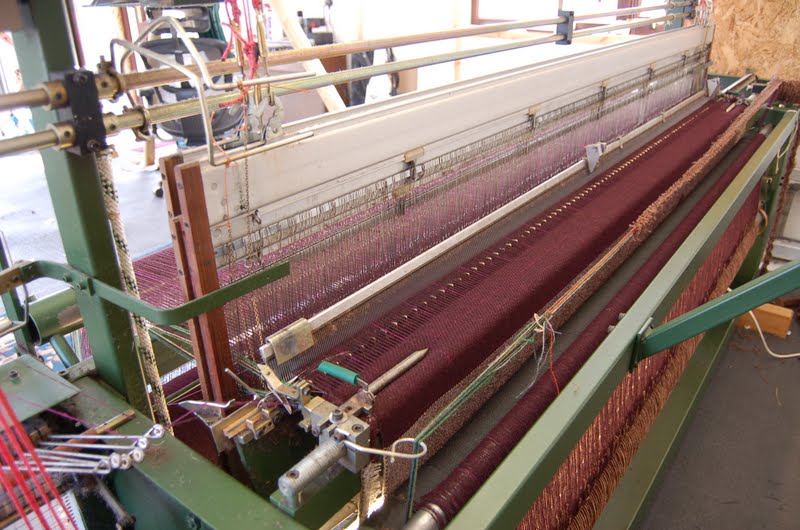
The 'back' of the loom, with all the threads - the warp - coming from the beam at the bottom. The threads have to be threaded individually through each heddle board.

Each one of these threads has to be tied to an existing, older thread on the loom - seen in the next photo at the bottom of the loom.

One thousand, four hundred and sixteen tie-ins. Yes, that's right, 1416 individual knots to be tied by hand. That's a lot of knots!

On the upper part of the loom, you can see the woven tweed.

The main colour of this tweed is the darker purple, and it has a pink thread running across and down, giving a pink check.

Can you see the pink thread and purple thread (bottom left of photo) running to the front of the loom? These threads are the weft.

The threads on the loom already (coming up from the beam) are also purple with the one pink thread every so often. For this thread, every 50 or so threads is pink.

Here's our weaver peddling to work the loom.

Part of the legislation governing the authenticity of Harris Tweed says that the loom must not be mechanically operated. Its work must be manual.

What a fantastic way to keep fit, don't you reckon!

When I was growing up, the clickety-clack sound of the loom was heard in every village. If my memory serves me correctly, this is the sound to which I woke on many mornings.

Clickety-clack....

Clickety-clack.

It's a good sound. It is in my memory anyway.

Here's Kathleen, peddling away busily.

The light underneath the loom makes it easy to see the threads, and any mistakes will be easy to find. Theoretically anyway.....eh, Kathleen?!

Here, towards the front of the loom (the right of the photo) you are able to see a couple of inches of the woven tweed. Just to the left of the woven tweed, you can see the warp. The rapier carries the weft to the other side, then back ...


 and fore...

 Legislation covering the making of Harris Tweed makes the industry a real cottage industry: no more than two looms are allowed under the same roof, and the great majority of Harris Tweed is woven by home-based weavers - normally, like Kathleen, weaving in a shed beside their home.


Although most of the island's weavers have traditionally been men, no doubt more and more people in Kathleen's position will see the benefits of this as a viable cottage industry.


Thanks, Kathleen, for allowing me into your weaving shed for a spell; thanks for showing this ignoramous a thing or two about the loom; and thanks for allowing me to hear the clickety-clack of the loom once again. It brought back happy memories...


5/19/2011

Harris Tweed, Part II

So.... Harris Tweed.

The Christian School on the island have been doing a project on Harris Tweed, so I bribed asked politely my American, Pennsylvanian, Northern friend, who is teaching in the school for a few months to tell me all she's learned about Harris Tweed.

Back to the very beginning....

Laurie, tell me a bit about the history of Harris Tweed.

People had been weaving cloth in Harris for hunderds of years, but when the widow of the Earl of Dunmore, who'd inherited the northern part of Harris, took over the running of the estate, the birth of Harris Tweed as we know it was to occur. Lady Dunmore realised that the cloth that two sisters, who are known as the Paisley sisters, were weaving was ideal for making jackets that were both wearable and durable. When she had jackets made for her own estate gamekeeper and ghyllies, Lady Dunmore knew that this clothing would suit her well-off friends in London, and on other estates, to a tee. She took samples to London, and with her encouragement it was not long before tweed jackets had become the clothing for the hunting, shooting set, including those working for Queen Victoria. It was not only practical, it was really the clothing to be seen in.

I took a drive down to Harris and saw where these ladies had lived and worked.

This plaque commemorates the 'Paisley Sisters', Marion and Christine MacLeod.

In the foreground is the remains of Marion and Christine's home.

Here is the house from another angle. See how close it was to the sea!

They would have washed the wool in this stream of running water, right bside their home.

Here is crotal, the lichen that was used to dye the wool.

This is a description of the original method of preparing the wool:

The raw material, wool, was produced locally and part of it would have been used in its natural uncoloured state, the rest was dyed. In the 19th century vegetable dyes were used. Following dyeing, the wool was mixed, the shade being regulated by the amount of coloured wool added; then it was oiled and teased; the latter process involves pulling the wool apart to open out the fibres. The next part of the preparation, carding, results in the fibres of the wool being drawn out preparatory to spinning. This was a very lengthy process followed by spinning carried out on familiar spinning-wheel by women. Until the turn of the century a very early type of handloom was used for weaving with a manually operated shuttle. The final process is finishing where the tweed is washed and given a raised compact finish. The involved in this process was often accompanied by songs in Gaelic. 
[From the Harris Tweed Authority website]

The success of the product soon led to imitations being produced, so in the early years of the 20th cenutry, genuine Harris Tweed was given legal protection and the famous Orb mark shows authentic Harris Tweed to this day. An Act of Parliament defines Harris Tweed like this:

Harris Tweed is cloth that has been handwoven by the islanders of Lewis, Harris, Uist and Barra in their homes, using pure virgin wool that has been dyed and spun in the Outer Hebrides.

Take note: 

- the cloth has to have been handwoven by the islanders of the Outer Hebrides;

- the wool must be pure virgin wool;

- the wool must be dyed and spun in the Outer Hebrides.


Originally the wool used on the island was from Blackface sheep, but now the wool comes to the island mills from the mainland, from Cheviot sheep.

 A prize Cheviot
[Photo: Selkirk Scotland website]

The wool comes to the island mills, all ready washed. The dyeing, carding and spinning is all done in the island mills. The mill then take the various yarns they have warped and prepare a beam for local weavers. The local weavers, weaving from their own homestead, put their delivered beam onto their own looms and weave the required length.

The famous Orb - the mark of genuine Harris Tweed

The Harris Tweed industry has been a mainstay for the island's economy for the past century. My dad had a business in the town here until he retired, and he always said that he barely noticed when other industries were busier or quieter, but when the 'tweeds' were on a downturn, the whole town was affected.

Tomorrow, I'll show y'all one of our local weavers at work, and try and show you how the loom actually works.


5/17/2011

Harris Tweed

Harris Tweed. Every heard of it?

If you have, what do you think of when you read the words ... Harris Tweed?

Old grannies' skirts. Old men's caps?

Well, you'd be forgiven, I guess, because for many years, tweed was the domain of the older folks; of men's jackets that never wore out; the chosen gear for the shootin', fishin' brigade.

But no longer: now Harris Tweed can be seen on the Paris catwalk and on movie stars. And in Nike trainers.

Harris Tweed has been handwoven in the Outer Hebrides for centuries. When the manufacture of other cloths was industrialised, during the age of industrialisation, Harris Tweed retained its distinctiveness by the nature of its manufacture: it was, and still is, handwoven in the Outer Hebrides.

The trademark, the Orb...


is protected, and can only be placed on cloth which has been produced on these islands, and by its distinctive method. In 1909, Harris Tweed was defined by the Harris Tweed Association as "hand-spun, hand-woven and dyed by the crofters and cottars in the Outer Hebrides."

Over the next week I'll show you some photos of the loom on which Harris Tweed is woven by numerous weavers on our island. 

I'll speak to a weaver and let y'all know some of the positives and the negatives of being in this line of work.

And I will speak of some other cottage industries that have been set up, making and selling Harris Tweed items.

Oh, and one more thing: I'll have a giveaway, and yes, it'll be connected with Harris Tweed. Watch this space!

Related Posts with Thumbnails