Showing posts with label island life. Show all posts

6/29/2012

Visiting the Arnol Blackhouse

We had the most fascinating visit to the Arnol Blackhouse today. It really was such an interesting visit and I am now in awe of those who lived here without all the modern amenities to which we are all accustomed.


We'll begin in the Living Room. This fire in the centre of the house is what makes this house so unique, and is what made Historic Scotland take the house over around 50 years ago. There are many other thatched houses preserved, but they have their fire in a fireplace and have a chimney.

This one - as you can see - has the fire on the slab in the middle of the floor, with the smoke rising to fill the house. 

And we'll begin with the smoke. When I went in the main door, the smell of the peat fire was the first thing that hit me. By the way, if you've never smelt a peat fire, you really are missing out on life. Big style.  I have to say that my own first thought was how bad this smoke must have been for those living in the black houses, but the smoke isn't all bad ...

If you look at the photo, you can see how blackened the rafters are. The soot actually helped preserve this wood. Even more fascinating, though, is that this same smoke which filtered out through the roof thatch killed bacteria which would have rotted the thatch. With the fire in the middle of the floor, the wood and thatch was protected and the lifespan of both was extended. 

In the photo you can see the partition between the living area and the bedroom. Notice that it doesn't reach the ceiling: that is so that the smoke is able to spread through the whole area of the house, and the benefits of the smoke reaches the whole roof area.

These dried plant stalks were used as hooks at times, but at other times, the folks hooked salted fish on them. They were hung from the ceiling and ... yes, you guessed it - they were smoked! 

Back to the first photo ...


The curtains surround the box-bed. The actual bedroom is through the doorway, but the blackhouse also has a box-bed in the living area. This bed was for anyone who was ill or elderly. In this particular house, this was the granny's bed. Having the granny or an ill person here meant they were close to the fire and were kept warm, but - most importantly - they were part of the family throughout the day.

This dresser was in the original house too, and all the dishes are exactly as the last occupants of the house had them. What is really interesting about the dresser is that it is made from driftwood. If you have never been in Lewis, you will not appreciate how tree-less the island is. There were simply no easy ways of finding wood for rafters, for box-beds or for furniture. And so driftwood was sought, and utilised. In fact, when a young couple were getting married, some driftwood was one of the best wedding gifts they could be given. 

If you look carefully at this wood (again, this is all exactly as the house was when it was being lived in) in one of the box-beds in the bedroom, you will see deep grooves in them. These grooves were made by sea worms and experts who have examined them have confirmed that the worms which made these grooves are found in the South Atlantic. This driftwood was swept from the South Atlantic to the shores on the west coast of Lewis. I guess that's the Gulf Stream for you!

The bedroom, with two box-beds, a table and two clothes chests.

Our fascinating and informative guide, here keeping the fire alive

At the other end of the living area from the bedroom was the byre. The two stalls here kept the cows, while the straw-filled boxes at the end were for the chickens. The opening above these is where the chickens  sauntered in and out at their leisure. 

Evidence has been found of similar houses to this in Norway and in other Scandinavian countries. They are also to be found in all the areas in which the Vikings ruled: Iceland, Scottish islands such as Shetland, Orkney and Lewis, and as far away as Newfoundland in Canada. The Vikings were in the north-east of North America long before Columbus discovered the continent. 

We had such a good time visiting this blackhouse today. A huge thank you to our guide, and a definite recommendation to anyone who hasn't visited and is able to.

Go visit! 

And ask for a 'live' tour guide. As we found out on the London buses - there just aint nothin' like it.


6/05/2012

Beacons for our Queen's Diamond Jubilee

As part of the Diamond Jubilee celebrations, communities all around our nation and the Commonwealth were lighting beacons last night (Monday 4th) at 10.15pm.


HM Queen Elizabeth II lit the final beacon in central London at 10.30pm.


Our most north-westerly corner of the UK had a beacon and it was lit by two of our best known and loved members of our community: 


The Deputy Lord-lieutenant of the Isles is from Ness, and she chose to have another member of our community light the beacon along with her.


Norman Smith, who is seen with our Deputy Lord-lieutenant in the photo below has been a mainstay in our community for decades, and I for one was delighted to see the choice of 'lighters'.


Before lighting the beacon, our Deputy Lord-lieutenant said this about Norman Smith (seen here with her):

"He is older than the Queen. On his 19th birthday, he was at Fort George. On his 20th birthday, he was on Italian shores. On his 21st birthday, he was a German prisoner of war."

Our generation would do well to remember what the older members of our communities have actually lived through.

The beacon was lit at 10.15pm, and you can see how bright it still was.

Beacons were lit in over four thousand locations up and down our land and throughout the Commonwealth. 

Having lit our beacon, we sang Psalm 23. The setting was beautiful and there was very little wind.

I expect to meet with Norman later this week, and hope to post about some of his life's experience. I count it a privilege to have him tell us his story.

Here's a view across the machair from where the beacon was lit.

And here, beyond the beacon, is 'Our Beach', shown from 'the other side'.


6/04/2012

St Kilda - Some of its Wildlife

If you haven't read the first post on St Kilda, have a click here

In this post, we'll look at some of the wildlife to be seen and savoured (or avoided) on and around St Kilda.

Gannet, mid-flight


The gannets here are nesting on Boreray.

Boreray, Stac Li and Stac an Armin boast the largest colony of Northern Gannet in the world, with around 60,000 breeding pairs. This was food for the St Kildans, and their men would cross to these rocks to lasso the birds. There is a small bothy still to be seen on Boreray, which the hunters used for shelter whilst on the rock. 


Just in case you don't realise: the Gannet is an adult Guga. You remember the guga, don't you? If not, have a read here.

Here they are, flying high above Boreray. This called for taking frequent cover on the boat.

The gannets nest on Stac Lee and you can see the abundance of their excrement (that's poop to you and me).

When the St Kildans hunted gannets on the precarious ledges on this rock, they'd fill bags which they'd drop down onto waiting boats. They knew nothing of safety ropes, and the 'Elf and Safety folks were not even a twinkle in anyone's eye at this stage. There's the story told of a time when some men came for their gannet hunt, but in the time they were away, disease hit the St Kilda islanders, leaving nobody to come and collect them. Apparently they spent months on the island before being 'rescued'.


Skua


Pictured here on St Kilda, the skua is a very aggressive bird. They are hugely protective of their nests, and  dive-bomb innocent passers-by.


They are not friendly. At all.


Fulmar. These friendly birds (ahem) have a nasty inclination to spit foul-smelling oil at anyone who comes too close.


Puffins. 


Unfortunately I wasn't able to get good photos of them. They really are lovely looking birds, with beautiful, colourful beaks.
Puffins burrow and nest in the ground 


After all these birds, I'm glad to get onto dry land again and show you ...

the St Kilda sheep. 

They are wild Soay sheep, and live on St Kilda to this day, despite the people having left many decades ago. 


Aren't they lovely.


The shed their own wool - you can see the sheep's fleeces here shedding. 


They're hardy beasts ...


On the journey to St Kilda, I saw some porpoises, and often there are dolphins to be seen. All in all, it's a worth while trip to make if wildlife is your interest.

5/25/2012

Butt of Lewis Lighthouse

Some interesting, though possibly useless, facts about our local lighthouse.


The lighthouse was built in 1862 by David Stevenson and his brother, Thomas. David Stevenson was an engineer with the Northern Lighthouse Board.

Thomas Stevenson was the father of the much loved author, Robert Louis Stevenson. 


It stands at almost the same latitude as Whitehorse, Yukon in Canada, and Kristiansand in Norway.


It is officially the windiest spot in the U.K, though tonight it was perfectly calm.

There used to be a foghorn beside it, which sounded until 1995. I have wonderful, comforting childhood memories of its deep, long, low bellow sounding out as I lay snuggled in my bed. 

Sadly, it is heard no more. And I miss it.


The lighthouse was manned when I was growing up. The flashing was caused by a huge lens which revolved around the light. Before it was automated, the lighthouse keeper had to wind up the clockwork motor by hand every half-hour each evening.


Initially, the light was fuelled by fish oil, but between 1869 and 1976 paraffin was used. Since 1976, it has been all electric. 


There are 168 steps to the top of the lighthouse. Sadly, the lighthouse is not open to the public now, so we cannot climb to its top any more. 

Interestingly, the man who was building the spiral stair of steps went on strike for 'an extra penny a day'. Apparently, there were so few experts to do the work that he was given what he'd asked for.


7/18/2011

Mir - A Full Rigged Ship, from Russia


This sailing ship was in Stornoway Harbour for a few days last week.

It's a Russian training ship called the MIR, and is the largest sailing ship in the world.

The photo here is a photo of a postcard, but I wasn't able to get any photos of the ship in full sail and I wanted y'all to see it.

Aint she a beauty!

Before she sailed from the harbour today, our local Lewis Pipe Band played on the pier - for the benefit of the waiting crowd and of the crew on board the vessel.

 She's not called a Tall Ship for nothing, I tell you.

 Here are two of the masts, with the Russian flag blowing in our breeze.

 And here are the pipe band playing their final piece to see her off.

with the crowd waving enthusiastically to the crew.

 She is owned by the Makarov State Maritime Academy in St Petersburg, and left Stornoway today to head to the Shetland Isles. A new crew will replace this one in Lerwick.

 Isn't she beautiful?

This was taken from the Bràigh (for any who know the island), and the sails still hadn't been raised.

About an hour later, when I reached our own house, I saw here clearly passing the northern part of the island. She had all her sails up and was a wonderful sight.

7/14/2011

Sheepdog Trials

There were sheepdog trials going on just down the road from us this afternoon, so we headed down to watch these amazing collies and their masters at work.
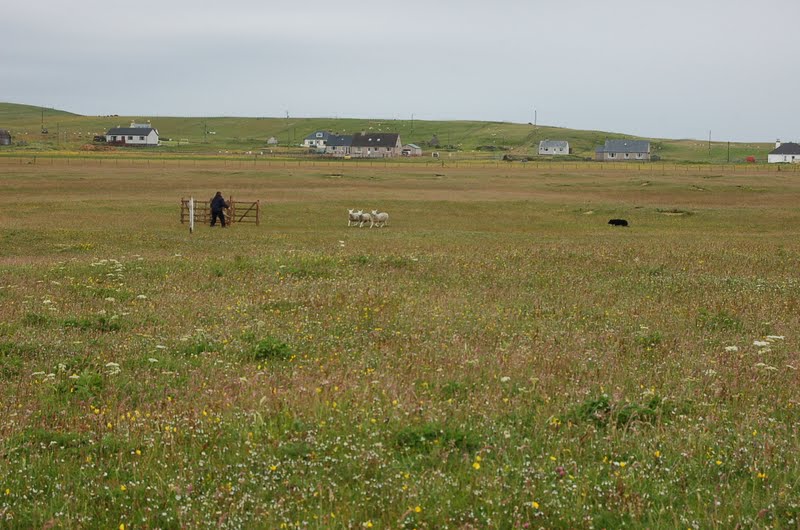
 None of the photos do justice to what is happening. 

 Shrill whistles - their differences almost imperceptible, but understood by these clever collies - guide them around the sheep, to their right, their left...

 Here's the dog having taken the sheep to the gate of the pen. He's now waiting for the master's next command, but meanwhile he's still. The sheep mustn't be spooked, otherwise they'll dash off and the whole process of getting them this far will have to begin again.

 Slowly....

 Stealthily...

 Until finally they're guided in.


 This dog wasn't competing. He was standing at the sidelines with his master. 


Oh boy, did he want to get his opportunity to shine. What a darling dog he was, but he has a bit of a way to go in his training before he can enter competitions.

Can you see the eagerness? One day, he's thinking. One day, that will be me.


Related Posts with Thumbnails