Showing posts with label guest post. Show all posts

1/10/2014

Red Farmhouse's Guest Post on Why we Homeschool


Here's another post from my Drafts folder. This one has been sitting there for a long time, and it comes from Kim at her lovely blog, Life in a Little Red Farmhouse

Kim and her husband and three sons live on a homestead in Oklahoma. Head over to the blog and see how they live their lives.


Here's a post that Kim posted on her blog quite some time back ...


Homeschooling - it sounds like a hard thing to do. Honestly, sometimes it is. But often difficult things are the most rewarding. And homeschooling has been rewarding for our family.

We are on our eleventh year in our homeschooling journey. I call it a journey because it is an ever changing road that we decided to walk down. I never thought we could make it this far. Somehow it has just worked for our family. Now it just seems a normal part of life. Teaching our boys spelling and math has been an extension of teaching them to eat with a spoon and to walk. Each year we evaluate each boy to decide if it is best for them. So far, homeschooling has been successful for each of them and so we continue on our road of learning together. I must admit, over the years I have learned as much as they have, not only about phonics and history but more importantly about myself.

Today, I wanted to answer a few questions about homeschooling that I have been asked over the last decade...

1. Why did you decide to homeschool your children?

I had an excellent example, my sister in law, that homeschooled before me. Silently, I observed them for years mulling it over in my mind. I would ask myself, "Can I do that?" When our oldest, went to Pre-K, he started getting in trouble. He was a very sweet boy and obedient but wiggly as most boys are and so he became very unhappy. We decide to give homeschooling a try. And then I knew, "I really can do this!"


2.What is your philosophy of education?

Our philosophy is simple: Build a foundation of faith. Add to that the basics: math, science, grammar and writing. Polish it off with an understanding of history and good age appropriate literature.

Teach them they can pick up any book at any time and learn something from it. Encourage each one in their strengths and help them along in their weaknesses. And have a little fun along the way.


3. What has been the best thing about homeschooling for you?

That's hard to pick just one thing. I'll give you the top two:
Character development has been the biggest plus in homeschooling our boys. It has given us the opportunity to know them better as they have grown, deal with issues that arise (and they always do), and mold and shape their character in a way that we never could have without homeschooling.
And second, they remain the best of friends to the point that they all still want to share a room together at ages 17, 14 and 11. I hope that this will last their entire lives. The truth is that friends come and friends go but close brothers last a lifetime.


4. What has been the hardest thing about homeschooling?

The knowledge that we are soley responsible for their education. It can be an overwhelming thing if you dwell on it. Now that I have one that will soon be off to college, I realize that taking one step at a time down a long path is the best way to get there.

I  when I feel like I'm failing, I comfort myself in the thought that no one wants my children to succeed more than I do.


5. How do you know what to teach?

Now days, there are endless options for curriculum. Most are very user friendly and require little work for the mom-teacher. This is a great thing especially when you have multiple ages. Whenever we can combine history, literature, or science and still be age appropriate for each child, we do.


Here is my list of go-tos: 
  • Math U See
  • Apologia Science
  • Easy Grammar
  • Institute for Excellence in Writing
  • Spelling Power
  • Wordly Wise Vocabulary
  • and my favorite - Sonlight literature and history

6. What do you do if there is something you just don't think you are qualified to teach?

It wasn't until high school that this even became an issue. With our oldest son reaching that stage a few years ago, we started taking advantage of private and group tutoring for science and math. Letting some very qualified ladies teach the things that were out of my comfort zone has worked out great for us. It has allowed me to still oversee the completion of the schoolwork and step in to help if needed but leave the heavy teaching to someone else. This year, I am trading off a subject with another mom. Her girls come to take drawing from me and she teaches writing composition to my boys. I love that. I also love that she doesn't mind teaching them outside even if it's on a fence post.


7. What about socialization?

There are so many opportunities for socializing with other homeschooled kids that you can not have enough time to do schoolwork. Over the years, my boys have been involved with a homeschooled Boy Scout troop and a weekly PE class as well as art classes, pottery, playgroups, book clubs, and even a Shakespeare club. I had a woman ask me once how my children were going to learn to stand in line. Funny, we were at that very moment in a check out line at Walmart. Is that really socialization anyway? Good socialization, in my opinion, is a child being able to relate and communicate with any age of person, something that homeschooled kids often do well.


8. If "school" doesn't take as long at home as it does in a classroom, what do you do with the rest of the day?

Oh, that has been the fun part and one of the reasons we built this farm. Keeping kids busy is important. Boys, especially as they get older, need something to do that makes them feel important. And they sure don't need more time in front of a screen. We have tried over the years to encourage life skills and hobbies.

Doing things like properly saddling your horse and taking it for a ride,


building something on their own,


caring for animals (yes, even falcons),


playing thinking games,


or even working for spending money, are all ways that our boys spend their days.


"Find something that you love, and do that", is what our boys hear us say on a regular basis. Education should not be all about the books.


Thanks, Kim, 


4/20/2013

My Baby is Ten. TEN! Guest Posting Today ...


Today, my baby - yes, my baby - reaches double figures. My friend, at The Joyful Keeper, asked me to Guest Post today, and re-tell some of the events that accompanied the birth of the Wee Guy, our youngest child. Head over to Caroline's blog, to read more of my experience on the day this baby was born ...


6/08/2012

St Kilda - Some History


St Kilda and the surrounding islands are now owned by the National Trust for Scotland, and is one of Scotland's World Heritage Sites.

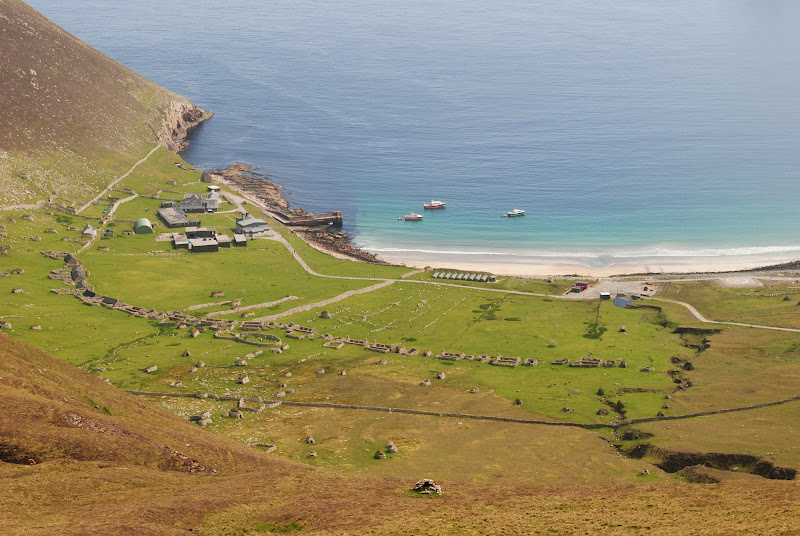
This photo was taken when we were almost at the top of Conachair (430 m, 1411 ft). The village houses can be seen in a line, and close to the sea.


Towards the top-left of the photo, you can see the MOD (Ministry of Defence) buildings. 

It would appear that people have lived on St Kilda for thousands of years. But little is known of life here before the 17th century. At one stage during the 18th century, the population had decreased by so much because of deaths from smallpox that other islanders from Harris were brought there to live. Then, in the middle of the 19th century, in 1851, thirty-six of their men emigrated to Australia.

That was a huge loss to the island, and St Kilda never really regained a healthy population after that.


The row of derelict homes. Most of the houses would have been thatched, though around 1862 some of the homes were given zinc roofs.


Until the 19th century, the people of St Kilda had very little contact with the outside world. The factor, or his representative, would arrive once a year to collect the islanders' rent - normally paid in wool, seabird eggs or such like. A chaplain would make the journey with the factor, and he would perform marriages and baptisms.


These goods would have been stored in a cleitean like the one below, ready for the factor's annual trip.


The gannets hunted on Stac Lee would have been stored here too. Along with this, the St Kildans' diet consisted of some potatoes and barley that they were able to grow, some sheep milk and cheese, and gannet and fulmar eggs. Amazingly, despite being surrounded by sea, they seldom fished. The seas were simply so rough that fishing was just not a reliable option for them.

This reminds me a little of, 'Water, water everywhere, and not a drop to drink'.


The church, which is the best preserved building on the island, was built in the 1800s, primarily through funds raised by The Apostle of the North. The schoolroom (on the right of the building in the photo) was built as an annexe to it.

You may have heard of The Apostle of the North. Rev John MacDonald visited St Kilda four times in all, preaching the Gospel to the people - most of whom lived with some knowledge of Christianity, but whose hopes tended to be placed in outward signs like baptism. The seed sown by Dr MacDonald saw considerable fruit.


I am wondering whether this cloth piece with the embroidered cross would really have been here.

To my Scottish Presbyterian mind, it seems unlikely. But if anyone knows differently, please let me know.


I love this - a map of the world on the classroom wall.

Islanders tend, I reckon, to be much more outward looking than those who live inland, and especially those who live in large towns or cities. Feel free to disagree with this observation, by the way! But it seems that way to me. How often the St Kildans must have traced the sea-path from St Kilda to Australia on this map. Had those who emigrated from St Kilda gone to Canada, it wouldn't have seemed so far. But Australia...? That really was about as far as they could have gone.

Many mothers' hearts must have been almost broken.

Eventually, in 1930, the last inhabitants of St Kilda left the island for good and settled in other parts of Scotland. They had had more contact with the outside world in the decades before this, and knowing there were other - more comfortable - ways of life made them keen to leave.   

And so, St Kilda now lies deserted of true St Kildans. Tourists visit in great numbers, and some wildlife - like the birds - thrive. The wild sheep have mixed fortunes, but surely the history of these hardy people will never be forgotten.


6/04/2012

St Kilda - Some of its Wildlife

If you haven't read the first post on St Kilda, have a click here

In this post, we'll look at some of the wildlife to be seen and savoured (or avoided) on and around St Kilda.

Gannet, mid-flight


The gannets here are nesting on Boreray.

Boreray, Stac Li and Stac an Armin boast the largest colony of Northern Gannet in the world, with around 60,000 breeding pairs. This was food for the St Kildans, and their men would cross to these rocks to lasso the birds. There is a small bothy still to be seen on Boreray, which the hunters used for shelter whilst on the rock. 


Just in case you don't realise: the Gannet is an adult Guga. You remember the guga, don't you? If not, have a read here.

Here they are, flying high above Boreray. This called for taking frequent cover on the boat.

The gannets nest on Stac Lee and you can see the abundance of their excrement (that's poop to you and me).

When the St Kildans hunted gannets on the precarious ledges on this rock, they'd fill bags which they'd drop down onto waiting boats. They knew nothing of safety ropes, and the 'Elf and Safety folks were not even a twinkle in anyone's eye at this stage. There's the story told of a time when some men came for their gannet hunt, but in the time they were away, disease hit the St Kilda islanders, leaving nobody to come and collect them. Apparently they spent months on the island before being 'rescued'.


Skua


Pictured here on St Kilda, the skua is a very aggressive bird. They are hugely protective of their nests, and  dive-bomb innocent passers-by.


They are not friendly. At all.


Fulmar. These friendly birds (ahem) have a nasty inclination to spit foul-smelling oil at anyone who comes too close.


Puffins. 


Unfortunately I wasn't able to get good photos of them. They really are lovely looking birds, with beautiful, colourful beaks.
Puffins burrow and nest in the ground 


After all these birds, I'm glad to get onto dry land again and show you ...

the St Kilda sheep. 

They are wild Soay sheep, and live on St Kilda to this day, despite the people having left many decades ago. 


Aren't they lovely.


The shed their own wool - you can see the sheep's fleeces here shedding. 


They're hardy beasts ...


On the journey to St Kilda, I saw some porpoises, and often there are dolphins to be seen. All in all, it's a worth while trip to make if wildlife is your interest.

6/01/2012

A Visit to St Kilda

Until you visit a place like St Kilda, you may think the Isle of Lewis is remote, and that Ness is at the very edge of the world. Today's post is a guest post, written by the illustrious C.A. Here are some of his thoughts, following a day trip to St Kilda.


Having been invited by a friend to go and see St Kilda I thought it best to jump at the opportunity. The Island is 40 miles west of Lewis and Harris and the last landfall before reaching the other side of the Atlantic.  Being an Islander myself I’ve always been fascinated by ‘remote’ places but I’m more aware now that our three hour ferry journey to mainland Scotland from Lewis is made less significant by the distance that St Kilda is from mainland Scotland. 

St Kilda is seen here at the far left of the photo.


My first thought on arrival here - whether it be right or wrong - but just because of the sheer remoteness of the place was: ‘No one should have lived here!’

St Kilda lies outside the British territorial sea limit!   Anyone who knows the climate of Lewis and Harris knows what it is to be battered by gales, to have a short growing season and to be under the constant effects of rain and dampness especially through the autumn and winter.  This sort of weather is easily multiplied out here due to it being in a nautical climate.  The grass and heather is short not just because it is kept down by the indigenous species of Soay Sheep but also because of such a harsh climate.


St Kilda and its surrounding outcrops is roughly 3 miles long and had a population which once peaked to 180.  The first government census took place only in 1851, and has the population at 110.  St Kilda has been uninhabited since 1930 now only hosts the Ministry of Defence which leases St Kilda from the National Trust for Scotland.   Due to the history of forced abandonment for health and welfare reasons the Island comes across as quite a sad place, rather like a graveyard.


So far I’ve painted quite a bleak picture of St Kilda but having spent the day there and observing its beauty from the highest point and in the midst of a Highland heatwave I am in awe of this ‘other world’ scenery.  There must have been happy days here also, families with children running about playing and exploring the islands sea caves and nooks and crannies.  The St Kildans would not just have been a community but also just like one large close knit family bringing with it all these social benefits.  In our modern communities of Lewis and Harris we have largely lost a sense of that community and now sadly we are even beginning to lose the idea of ‘family’.  It is easy for us to look on with pity on a community which lived such a hard life without the benefits of appropriate healthcare, but what would the St Kildans say of us today and our so called ‘developed’ society.

I found myself in awe of the sight of the giant sea stacs next to St. Kilda which are some of the highest in Europe and a hive of activity to the largest Northern Gannet population,  Stac Lee is the highest of the Stacs and rises vertically to 191m and plunges into the depths of the sea.  As we sailed under the overhang of stac Lee I was reminded of a personally precious text, “Lead me to the rock that higher is than I” Psalm 61 v2. 


This is not an ‘old’ earth, even though some scientists tell us how islands were formed millions of years ago under volcanic activity. Out here, I see part of the creation which, under God’s wrath on man’s sin, underwent the purging of the great flood of Genesis resulting in the seismic volcanic activity making the volcanic archipelago of St. Kilda.  Romans chapter  8 v22 says, ‘For we know that the whole creation groans and travails in pain together until now’.  

Here are some more photos from my trip:


Leaving Uig, Lewis. If you think this looks remote, you aint seen nothin' yet.


Inside the boat


and outside the boat!


Before we reach St Kilda, we pass Stac Lee which, along with Stac an Armin are the highest sea stacks in the UK.

 'Lead me to the Rock which is higher than I' (Psalm 61).


On St Kilda, there are indingenous sheep to be found. Their population fluctuates: at times, their numbers fall because of illness or lack of food. The subsequent lower number allows for better feeding conditions, and so their numbers increase until the next similar cycle begins.


The island is so stony, and the St Kildans built these stone cleiteanan in great number. In fact, there are around 1400 of them on St Kilda. They were used for the storage of food and fuel.


Stone fanks, built in odd shapes. Nobody seems to know why they were built in these shapes.


From higher up the hill, showing a fank and the harbour.


In the next St Kilda post, we'll look specifically at some of the wildlife I saw.

12/01/2010

Why Study Church History?

This is a guest post by Rick from RickandSusanna.
Christian History is a fascinating, deeply important topic. A friend recently asked me why I love it and so, without further ado, here are 6 reasons:

Church history answers tough, foundational questions

As a young Christian I had tough nagging questions for which I could never find satisfactory answers… until studying church history.
For example, the canonization of scripture: Why is the Bible made of these particular 66 books? Who chose them? Where did they come from? What criteria did they use? What books didn’t make the cut and why? Why do catholics have a different set of books? When was the canon established and what of the church before that time?
Church History helped answer these questions and bring peace that I can trust my Bible. Likewise with many other foundational questions.

Church history teaches the continuity of our faith and beliefs

Especially as a child raised in the Protestant Church, continuity was a question looming large in my mind. I wanted certainty I had not been duped by some crazy left turn in the 1500s. Through all the trouble and turmoil of the ancient and early Church, a study of her history reveals God’s work on a faithful remnant, the Church universal. A core orthodoxy stretches from the apostles down to us today. Yes, I can tie my faith back to the beginning. Church history helps me understand where I’ve come from and who I am!

History provides a context to better understand doctrine

The Church began as a child and grew into maturity. She faced challenges and questions over time, but overcame them one by one. Rather than swallowing two millenia of theological discourse, through Church history we have the opportunity to build and layer our personal knowledge in manageable bites. Furthermore, doctrinal statements come alive when understanding the historical context. Doctrine is not a collection of irrelevant or superfluous ideas. Rather, doctrinal statements arose in the face of real world issues. Issues that matter to our lives today.

The past provides a warning for the future and builds discernment

One might be surprised to find the popular trends and thoughts of the church today clearly playing out in the past. Ideas cast as fresh and new are often nothing more than a resurgent historical concept – whether known or unknown to those swept up in the idea. We can understand where trends and ideas are likely to lead by understanding our past. We can build discernment to see beyond the surface. No one wakes up and decides to be a heretic. Knowledge of the past builds a reservoir to signal red flags when appropriate, to know the questions to ask, and keep us moving in the straight and narrow by avoiding the mistakes of the past.

Inspiring heroes to personally identify with

Far from a dry collection of facts, history provides thousands of real heroes. Some with backgrounds or personalities like ours which can bring encouragement to see God using such individuals. Others we find so unlike us in accomplishment that we are challenged or inspired. Still others faced situations so incomprehensibly dire compared to our own that we are humbled. Nothing teaches and sticks with us quite like the examples of others.

Christian History builds faith by revealing how God still moves in his Church

History is messy. Our heroes imperfect. Yet God is always at work.
The light of the gospel – “its flame often sank low, and appeared about to expire, yet never did it wholly go out. God remembered His covenant with the light, and set bounds to the darkness” (J.A. Wylie).  Christian history tells, “How that seed was deposited in the soil; how the tree grew up and flourished despite the furious tempests that warred around it; how, century after century, it lifted its top higher in heaven, and spread its boughs wider around” (Wylie).

Resourceshttp://www.rickandsusanna.com/

Related Posts with Thumbnails