6/19/2012

London I - Madame Tussauds

Where on earth do I begin? I had such a wonderful trip to London - it was way beyond anything I'd expected. I'll begin with our visit to Madame Tussauds - probably the one place we wouldn't visit again. However, having dropped in, we made the most of it! I tried some of the wax models out for size.


(I didn't know this fella's name, and I do apologize profusely to any of you who are huge huge fans of his.)

Anyway, he's tall. Very, very tall.

I couldn't go wrong with a Scotsman, could I? 

Is Sean really this tall?

Ahhh, Bruce. TALL.

Colin.... Do folks not get dizzy at this height?

Er...  Pass.

I don't know how this photo sneaked its way in here. Both Dawn and I checked out the names on the wall, but we were still none the wiser. Sorry guys, I know you must be very famous, because you were one of the few models with an 'official' photographer.

Back to the height thing.

I saw Bruce, so I had to see John Wayne. After all, I couldn't come home telling one ram I'd seen his namesake, and not the other's.

John Wayne. Erm, what's with the stance?

Moving on...

Man Alive! The height of this guy! Boris Becker is t-a-l-l.

I wasn't able to stand beside these folks, but it was nice to say Hi.

But this Boris was very welcoming. Even given that he's standing on a plinth, he is tall.

Very tall.

You will notice that all the guys I've been photographed with are tall.

It aint me that's small.


I was just beginning to worry that the only fella in the whole place for me was going to be the French ex-President, when I found ...

My Ideal Man

So why would I not visit again?


Well, there are so many things to do in London that a place has to be very, very interesting for a second visit to be justified. But apart from that, I think I may be a bit old for the noise. It was like being at a disco (though I don't think there is such a thing as a disco any more, is there?!). It was noisy, there were quite a number of models we didn't recognise and there was a Horror Dungeon. That is not my cup o' tea, and parents would certainly have to be warned before taking children. It was definitely not suitable for younger children, and we didn't even see the worst part (which was avoidable, unlike the part we did see).


I didn't hate it, but I thought I'd begin my holiday posts with what was my least favourite site. It's all up from here, so hang about for the rest of the holiday news. 


Have I mentioned that I loved London? 


Okay, okay. But it is worth repeating.


6/11/2012

Off to London...

For those of you who don't follow the Facebook Home on the Croft page, here's a link to a sermon I heard the other day called The Dignity and Beauty of Manual Labor. Yes, that's 'Labor' spelled the American way because it was preached in the USA, albeit by a Scot.


And so to today: I'm off to London to see the Queen. Well, the 'to see the Queen part' may not be entirely accurate. When I spoke to HM the other day, I told her I felt she and Prince Philip really needed to rest after their grueling week of events and illness. Her Maj understands, and hopes the next time I come to London, I will be able to have Tea at the Palace. 


In that I visit London frequently, that shouldn't be a problem.


Talking of visiting London, I must go and pack. 


~    ~    ~

Okay, I'm back now, having at least gathered my wits my clothes. I am now going to have my second breakfast of the day, the first one having been at ridiculous-o'clock. Remembering that plenty food and plenty fluids is the way to stop myself getting headaches, I feel quite justified in eating Breakfast #2 at the late morning hour of 9am.


And speaking of food ... We are also going to Paris for a day. 


I'm sorry, did you catch what I said?


We. Are. Going. To. Paris.


"Je regret, mai je ne parlez pas Francais."

I really wish I did, but this is one of my only phrases. "I'm sorry, but I do not speak French.". Shame on me.


I was saying to The Girls (oh, did you know that my friends are The Girls. My own girls think this is hilarious, as anyone over 30 is a lady, and anyone of 40 is ... well, next door to being elderly)


Anyway, I was saying to The Girls that as we are in Paris from around 11am, we can begin our French experience with morning coffee at a Parisian coffee shop.


Sound good?


Then we have lunch, afternoon tea and dinner before heading back to London. 


I do believe we may manage a quick glimpse of the Eiffel Tower and the Champs Elysee, but they cannot be our priorities, right?


This time, I really do have to leave y'all to pack. I do have something of a history when it comes to being late ....


No doubt, I shall post photos a-plenty on Facebook, but I doubt I'll be posting here until I'm back in civilization.


Bon Vogage (that's me talking to myself - a frequent occurrence, so nothing with which to concern yourselves).

6/09/2012

A Very Late Visit on Patrice's Porch


I am so late joining Patrice and the crew on her porch this week. But, living the way I live, the mantra 'Better late than never' is never far from my lips. And so, onto this week's questions.


1. If you wear a hat, what kind is it mostly likely to be?


In the winter, I would wear something warm to keep my ears from the cold, but I hate the feeling of tightness on my head. Sadly, the need for floppy hats to keep the sun of my face in summer is almost non-existent. So, apart from wearing  something on my head for church services, I really never wear a hat. 


2. Do you wear perfume or cologne (ever)?


When I had my first baby, and especially because I was feeding him myself, I stopped wearing perfume. I always felt it was too strong for a baby to be breathing in whilst feeding. I almost never wore perfume over the past nineteen years, but last Christmas, the Builder bought me a bottle of perfume.


Let me say that more slowly: The. Builder. Bought. Me. Perfume.


Did y'all get that?

I love it, and wear it if I go out anywhere. Of course I don't go out much, so I'm expecting the bottle to last for quite some time ;)


3. What's your favourite snack whilst watching movies or television? (crisps, nuts etc)


Crisps? Nuts? Oh no, Patrice! Chocolate is my snack of choice every single time.


Oh, and I hate to break it to you, but you Americans don't know anything of what our chocolate tastes like. You need to come and pay us a visit to know the delights of my evening delights.


A friend of ours (CA, who visited St Kilda last week, and whose visit there led to Post 1, Post 2 and Post 3 on St Kilda) arrived the other evening with the most delightful gift imaginable. 

A whole box of Cadbuy's Creme Eggs. 

We choose our friends wisely.


4. What's the last gift you purchased or made?


Well, I may have purchased a gift which hasn't been given yet to the recipient, so I shall keep that quiet! Of gifts that have been dispatched ...


The Wee Guy had his birthday last month and he was given a goal, a football (a spherical soccer ball!), and Mist the Sheepdog DVDs, which he absolutely loves. 


5. Please finish this sentence: Before summer is over, I hope I've _____________ .


Patrice, I have a LIST that would finish that sentence. Here are two of the bigger To-dos:


* Our kitchen/dining area is to be finished. This means installing the solid-fuel stove, and painting the whole room.


* Our office: we need to decide on how we are going to use this room, and sort it to make it fit for purpose.

~    ~    ~


Thanks, Patrice, for your questions again. I've missed our weekly chats, and hope I'll be able to be with you more regularly from now on ...


Except... next week. Because next week - are you ready for this? - I am going to be in London!


Yes, a friend and I are heading to our capital for a week of sightseeing. No doubt, there will be a few photos taken over the week!


This photo has nothing in the world to do with what I've just been saying, but I absolutely love the depth of the blue in the sky here and so I'm posting it because ... well, because I can.


6/08/2012

St Kilda - Some History


St Kilda and the surrounding islands are now owned by the National Trust for Scotland, and is one of Scotland's World Heritage Sites.

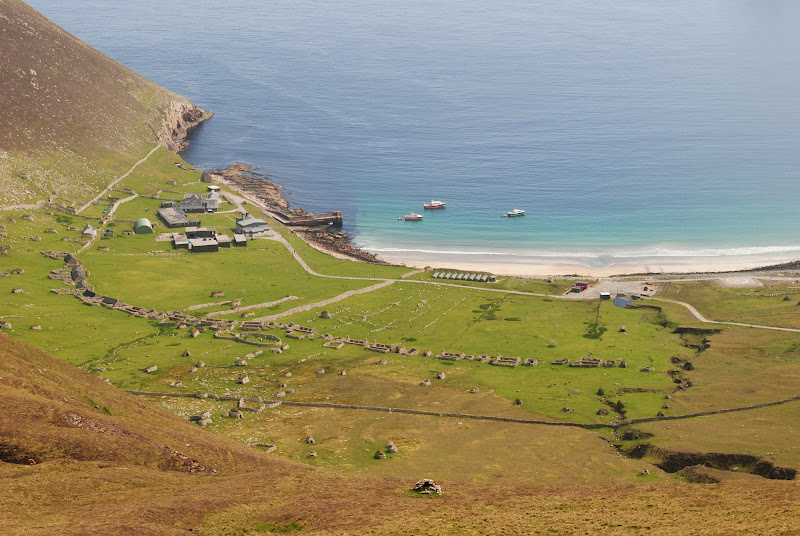
This photo was taken when we were almost at the top of Conachair (430 m, 1411 ft). The village houses can be seen in a line, and close to the sea.


Towards the top-left of the photo, you can see the MOD (Ministry of Defence) buildings. 

It would appear that people have lived on St Kilda for thousands of years. But little is known of life here before the 17th century. At one stage during the 18th century, the population had decreased by so much because of deaths from smallpox that other islanders from Harris were brought there to live. Then, in the middle of the 19th century, in 1851, thirty-six of their men emigrated to Australia.

That was a huge loss to the island, and St Kilda never really regained a healthy population after that.


The row of derelict homes. Most of the houses would have been thatched, though around 1862 some of the homes were given zinc roofs.


Until the 19th century, the people of St Kilda had very little contact with the outside world. The factor, or his representative, would arrive once a year to collect the islanders' rent - normally paid in wool, seabird eggs or such like. A chaplain would make the journey with the factor, and he would perform marriages and baptisms.


These goods would have been stored in a cleitean like the one below, ready for the factor's annual trip.


The gannets hunted on Stac Lee would have been stored here too. Along with this, the St Kildans' diet consisted of some potatoes and barley that they were able to grow, some sheep milk and cheese, and gannet and fulmar eggs. Amazingly, despite being surrounded by sea, they seldom fished. The seas were simply so rough that fishing was just not a reliable option for them.

This reminds me a little of, 'Water, water everywhere, and not a drop to drink'.


The church, which is the best preserved building on the island, was built in the 1800s, primarily through funds raised by The Apostle of the North. The schoolroom (on the right of the building in the photo) was built as an annexe to it.

You may have heard of The Apostle of the North. Rev John MacDonald visited St Kilda four times in all, preaching the Gospel to the people - most of whom lived with some knowledge of Christianity, but whose hopes tended to be placed in outward signs like baptism. The seed sown by Dr MacDonald saw considerable fruit.


I am wondering whether this cloth piece with the embroidered cross would really have been here.

To my Scottish Presbyterian mind, it seems unlikely. But if anyone knows differently, please let me know.


I love this - a map of the world on the classroom wall.

Islanders tend, I reckon, to be much more outward looking than those who live inland, and especially those who live in large towns or cities. Feel free to disagree with this observation, by the way! But it seems that way to me. How often the St Kildans must have traced the sea-path from St Kilda to Australia on this map. Had those who emigrated from St Kilda gone to Canada, it wouldn't have seemed so far. But Australia...? That really was about as far as they could have gone.

Many mothers' hearts must have been almost broken.

Eventually, in 1930, the last inhabitants of St Kilda left the island for good and settled in other parts of Scotland. They had had more contact with the outside world in the decades before this, and knowing there were other - more comfortable - ways of life made them keen to leave.   

And so, St Kilda now lies deserted of true St Kildans. Tourists visit in great numbers, and some wildlife - like the birds - thrive. The wild sheep have mixed fortunes, but surely the history of these hardy people will never be forgotten.


6/05/2012

Beacons for our Queen's Diamond Jubilee

As part of the Diamond Jubilee celebrations, communities all around our nation and the Commonwealth were lighting beacons last night (Monday 4th) at 10.15pm.


HM Queen Elizabeth II lit the final beacon in central London at 10.30pm.


Our most north-westerly corner of the UK had a beacon and it was lit by two of our best known and loved members of our community: 


The Deputy Lord-lieutenant of the Isles is from Ness, and she chose to have another member of our community light the beacon along with her.


Norman Smith, who is seen with our Deputy Lord-lieutenant in the photo below has been a mainstay in our community for decades, and I for one was delighted to see the choice of 'lighters'.


Before lighting the beacon, our Deputy Lord-lieutenant said this about Norman Smith (seen here with her):

"He is older than the Queen. On his 19th birthday, he was at Fort George. On his 20th birthday, he was on Italian shores. On his 21st birthday, he was a German prisoner of war."

Our generation would do well to remember what the older members of our communities have actually lived through.

The beacon was lit at 10.15pm, and you can see how bright it still was.

Beacons were lit in over four thousand locations up and down our land and throughout the Commonwealth. 

Having lit our beacon, we sang Psalm 23. The setting was beautiful and there was very little wind.

I expect to meet with Norman later this week, and hope to post about some of his life's experience. I count it a privilege to have him tell us his story.

Here's a view across the machair from where the beacon was lit.

And here, beyond the beacon, is 'Our Beach', shown from 'the other side'.


6/04/2012

St Kilda - Some of its Wildlife

If you haven't read the first post on St Kilda, have a click here. 

In this post, we'll look at some of the wildlife to be seen and savoured (or avoided) on and around St Kilda.

Gannet, mid-flight


The gannets here are nesting on Boreray.

Boreray, Stac Li and Stac an Armin boast the largest colony of Northern Gannet in the world, with around 60,000 breeding pairs. This was food for the St Kildans, and their men would cross to these rocks to lasso the birds. There is a small bothy still to be seen on Boreray, which the hunters used for shelter whilst on the rock. 


Just in case you don't realise: the Gannet is an adult Guga. You remember the guga, don't you? If not, have a read here.

Here they are, flying high above Boreray. This called for taking frequent cover on the boat.

The gannets nest on Stac Lee and you can see the abundance of their excrement (that's poop to you and me).

When the St Kildans hunted gannets on the precarious ledges on this rock, they'd fill bags which they'd drop down onto waiting boats. They knew nothing of safety ropes, and the 'Elf and Safety folks were not even a twinkle in anyone's eye at this stage. There's the story told of a time when some men came for their gannet hunt, but in the time they were away, disease hit the St Kilda islanders, leaving nobody to come and collect them. Apparently they spent months on the island before being 'rescued'.


Skua


Pictured here on St Kilda, the skua is a very aggressive bird. They are hugely protective of their nests, and  dive-bomb innocent passers-by.


They are not friendly. At all.


Fulmar. These friendly birds (ahem) have a nasty inclination to spit foul-smelling oil at anyone who comes too close.


Puffins. 


Unfortunately I wasn't able to get good photos of them. They really are lovely looking birds, with beautiful, colourful beaks.
Puffins burrow and nest in the ground 


After all these birds, I'm glad to get onto dry land again and show you ...

the St Kilda sheep. 

They are wild Soay sheep, and live on St Kilda to this day, despite the people having left many decades ago. 


Aren't they lovely.


The shed their own wool - you can see the sheep's fleeces here shedding. 


They're hardy beasts ...


On the journey to St Kilda, I saw some porpoises, and often there are dolphins to be seen. All in all, it's a worth while trip to make if wildlife is your interest.

6/01/2012

A Visit to St Kilda

Until you visit a place like St Kilda, you may think the Isle of Lewis is remote, and that Ness is at the very edge of the world. Today's post is a guest post, written by the illustrious C.A. Here are some of his thoughts, following a day trip to St Kilda.


Having been invited by a friend to go and see St Kilda I thought it best to jump at the opportunity. The Island is 40 miles west of Lewis and Harris and the last landfall before reaching the other side of the Atlantic.  Being an Islander myself I’ve always been fascinated by ‘remote’ places but I’m more aware now that our three hour ferry journey to mainland Scotland from Lewis is made less significant by the distance that St Kilda is from mainland Scotland. 

St Kilda is seen here at the far left of the photo.


My first thought on arrival here - whether it be right or wrong - but just because of the sheer remoteness of the place was: ‘No one should have lived here!’

St Kilda lies outside the British territorial sea limit!   Anyone who knows the climate of Lewis and Harris knows what it is to be battered by gales, to have a short growing season and to be under the constant effects of rain and dampness especially through the autumn and winter.  This sort of weather is easily multiplied out here due to it being in a nautical climate.  The grass and heather is short not just because it is kept down by the indigenous species of Soay Sheep but also because of such a harsh climate.


St Kilda and its surrounding outcrops is roughly 3 miles long and had a population which once peaked to 180.  The first government census took place only in 1851, and has the population at 110.  St Kilda has been uninhabited since 1930 now only hosts the Ministry of Defence which leases St Kilda from the National Trust for Scotland.   Due to the history of forced abandonment for health and welfare reasons the Island comes across as quite a sad place, rather like a graveyard.


So far I’ve painted quite a bleak picture of St Kilda but having spent the day there and observing its beauty from the highest point and in the midst of a Highland heatwave I am in awe of this ‘other world’ scenery.  There must have been happy days here also, families with children running about playing and exploring the islands sea caves and nooks and crannies.  The St Kildans would not just have been a community but also just like one large close knit family bringing with it all these social benefits.  In our modern communities of Lewis and Harris we have largely lost a sense of that community and now sadly we are even beginning to lose the idea of ‘family’.  It is easy for us to look on with pity on a community which lived such a hard life without the benefits of appropriate healthcare, but what would the St Kildans say of us today and our so called ‘developed’ society.

I found myself in awe of the sight of the giant sea stacs next to St. Kilda which are some of the highest in Europe and a hive of activity to the largest Northern Gannet population,  Stac Lee is the highest of the Stacs and rises vertically to 191m and plunges into the depths of the sea.  As we sailed under the overhang of stac Lee I was reminded of a personally precious text, “Lead me to the rock that higher is than I” Psalm 61 v2. 


This is not an ‘old’ earth, even though some scientists tell us how islands were formed millions of years ago under volcanic activity. Out here, I see part of the creation which, under God’s wrath on man’s sin, underwent the purging of the great flood of Genesis resulting in the seismic volcanic activity making the volcanic archipelago of St. Kilda.  Romans chapter  8 v22 says, ‘For we know that the whole creation groans and travails in pain together until now’.  

Here are some more photos from my trip:


Leaving Uig, Lewis. If you think this looks remote, you aint seen nothin' yet.


Inside the boat


and outside the boat!


Before we reach St Kilda, we pass Stac Lee which, along with Stac an Armin are the highest sea stacks in the UK.

 'Lead me to the Rock which is higher than I' (Psalm 61).


On St Kilda, there are indingenous sheep to be found. Their population fluctuates: at times, their numbers fall because of illness or lack of food. The subsequent lower number allows for better feeding conditions, and so their numbers increase until the next similar cycle begins.


The island is so stony, and the St Kildans built these stone cleiteanan in great number. In fact, there are around 1400 of them on St Kilda. They were used for the storage of food and fuel.


Stone fanks, built in odd shapes. Nobody seems to know why they were built in these shapes.


From higher up the hill, showing a fank and the harbour.


In the next St Kilda post, we'll look specifically at some of the wildlife I saw.

Related Posts with Thumbnails