Showing posts with label History. Show all posts

4/19/2013

Our Visit to the Houses of Parliament


The day we were able to visit the Houses of Parliament  ... Oh, and while I remember, could you all give a bit shout-out to Javier, please. Thank you, Javier! - Javier was our guide, and patiently put up with my ooh-ing, ahh-ing, my meditating, my slowness, my looking, my dreaming.

He and the Builder allowed me to stand and "just imagine ....". Often. 

There was, after all, a lot to 'just imagine'.

I stood at the Dispatch Box, where we see our Prime Minister standing each week to answer Prime Minister's Questions. I stood and quietly said, 

"Just imagine .... Winston Churchill stood here. Right here where I'm standing, he stood and spoke to his fellow MPs of the dire situation our nation was facing. In previous years, he'd spoken of the dreadful threat of fascism, of Britain's love of liberty and of the need to fight for it - to the death, if necessary. Some wished he'd stop rambling on about dangers from without, and dangers from within, and live and let live and let everyone get on with their lives in peace. Yes, some wished that. I'm guessing he wished he could too, but the truth had to be spoken, and right there where I stood - on that very spot, at that very table - Churchill had stood."

"Just imagine," I said to the Builder, "I am standing exactly where he stood. Right here."

And after the imagining, my mind went to times I remembered.

"Maggie stood right here when she proclaimed, 'I'm enjoying this!' ". Javier was too young to have remembered, and I'm not sure Maggie's last stand against socialism is too often talked about in his office! The Builder smiled indulgently. 

"Yes, darling. I've seen that ... Yep, she stood right there."


It is strange to stand in the very place where history has been made, and where it continues to be made. I wished I could have stayed for as long as I wished. On my own. I'm sure I'd have felt ready to leave at some stage - maybe sometime before dark .... Well, we will never know how long I'd have wished to stay, because we had to move on to see other parts of this strikingly beautiful building.

First, its sense of history strikes you.

Then, its beauty strikes you.

Finally, the size strikes you. The Chamber of the House of Commons is so small. The politicians that shout at each other across the chamber are only yards from each other. How can they be so rude!

I could see in my mind's eye Sir Geoffrey giving his resignation speech. 'Right there,' I pointed. 'That's where he was when he stood to speak'. 

I could see Dennis Skinner, in his own seat. In my mind's eye, he was still on the Government side of the House. 

I could see our own MP, Angus Brendon McNeill, and where he sits. 

I could see the House of Commons when it's 'standing room only', and hear the commotion of PMQs.

Can you tell I loved being there? Yes, I thought you probably could!

And the distance between the House of Commons and the House of Lords is so short. The door to the Commons, with its damage, caused by the Mace knocking to call the 'Commoners' to hear the Queen's speech.

When the Monarch speaks at the State Opening of Parliament each year, all are called to attend His, or Her Majesty. To  make a point, the House of Commons closes its doors to say, in effect, 'Nobody tells us what to do'. Parliament is supreme you see. The members of the House of Commons then come through to the Lords' Chamber to hear the Queen's Speech. You may have seen them on television, dawdling in - again making the point that 'we will come in our time. No monarch will tell us what to do.'

Silly traditions?? Some say so, but each element is there for a reason. I don't think the fact of the supremacy of parliament is 'silly'. There is no harm, then, in keeping the quaint ways of showing it.

And there it all is, wrapped together in that wonderful building. No wonder our politicians are in danger of living 'in a bubble'. It really is another world in there. A world I was happy to visit. A world I'd visit again and again if I had the opportunity. Indeed, it's a world in which I'd love to get lost ... If only the Builder and Javier would wander off somewhere and leave me.

Oh well, that wasn't to be, so it's back to reality.

The only part of the building in which we were allowed to take photos was Westminster Hall, the oldest part of the Palace of Westminster. Westminster Hall dates back to the time of William II.


Our Queen has addressed the members of both Houses here - the House of Commons and the House of Lords - a number of times, including at the time of her Silver Anniversary, her Golden Anniversary and, most recently, at her Diamond Anniversary.

President Obama has also stood where I stood to take the photo and addressed the two Houses, as has Nelson Mandela.

I think the latest person to be given this honour is Aung San Suu Kyi, the Burmese pro-democracy leader.

Monarchs and the queens of monarchs have lain in state here, and Sir Winston Churchill's body lay here in state before his funeral.

So much has happened right here. The trials of Charles I took place here, and of William Wallace who was, interestingly, charged with being a Scottish Patriot. He was not charged with treason as others were.

As I say, so much history; so much to interest, but more on this day of our holiday in the next post.

(Are you tempted yet to visit London?!)


6/29/2012

Visiting the Arnol Blackhouse

We had the most fascinating visit to the Arnol Blackhouse today. It really was such an interesting visit and I am now in awe of those who lived here without all the modern amenities to which we are all accustomed.


We'll begin in the Living Room. This fire in the centre of the house is what makes this house so unique, and is what made Historic Scotland take the house over around 50 years ago. There are many other thatched houses preserved, but they have their fire in a fireplace and have a chimney.

This one - as you can see - has the fire on the slab in the middle of the floor, with the smoke rising to fill the house. 

And we'll begin with the smoke. When I went in the main door, the smell of the peat fire was the first thing that hit me. By the way, if you've never smelt a peat fire, you really are missing out on life. Big style.  I have to say that my own first thought was how bad this smoke must have been for those living in the black houses, but the smoke isn't all bad ...

If you look at the photo, you can see how blackened the rafters are. The soot actually helped preserve this wood. Even more fascinating, though, is that this same smoke which filtered out through the roof thatch killed bacteria which would have rotted the thatch. With the fire in the middle of the floor, the wood and thatch was protected and the lifespan of both was extended. 

In the photo you can see the partition between the living area and the bedroom. Notice that it doesn't reach the ceiling: that is so that the smoke is able to spread through the whole area of the house, and the benefits of the smoke reaches the whole roof area.

These dried plant stalks were used as hooks at times, but at other times, the folks hooked salted fish on them. They were hung from the ceiling and ... yes, you guessed it - they were smoked! 

Back to the first photo ...


The curtains surround the box-bed. The actual bedroom is through the doorway, but the blackhouse also has a box-bed in the living area. This bed was for anyone who was ill or elderly. In this particular house, this was the granny's bed. Having the granny or an ill person here meant they were close to the fire and were kept warm, but - most importantly - they were part of the family throughout the day.

This dresser was in the original house too, and all the dishes are exactly as the last occupants of the house had them. What is really interesting about the dresser is that it is made from driftwood. If you have never been in Lewis, you will not appreciate how tree-less the island is. There were simply no easy ways of finding wood for rafters, for box-beds or for furniture. And so driftwood was sought, and utilised. In fact, when a young couple were getting married, some driftwood was one of the best wedding gifts they could be given. 

If you look carefully at this wood (again, this is all exactly as the house was when it was being lived in) in one of the box-beds in the bedroom, you will see deep grooves in them. These grooves were made by sea worms and experts who have examined them have confirmed that the worms which made these grooves are found in the South Atlantic. This driftwood was swept from the South Atlantic to the shores on the west coast of Lewis. I guess that's the Gulf Stream for you!

The bedroom, with two box-beds, a table and two clothes chests.

Our fascinating and informative guide, here keeping the fire alive

At the other end of the living area from the bedroom was the byre. The two stalls here kept the cows, while the straw-filled boxes at the end were for the chickens. The opening above these is where the chickens  sauntered in and out at their leisure. 

Evidence has been found of similar houses to this in Norway and in other Scandinavian countries. They are also to be found in all the areas in which the Vikings ruled: Iceland, Scottish islands such as Shetland, Orkney and Lewis, and as far away as Newfoundland in Canada. The Vikings were in the north-east of North America long before Columbus discovered the continent. 

We had such a good time visiting this blackhouse today. A huge thank you to our guide, and a definite recommendation to anyone who hasn't visited and is able to.

Go visit! 

And ask for a 'live' tour guide. As we found out on the London buses - there just aint nothin' like it.


6/08/2012

St Kilda - Some History


St Kilda and the surrounding islands are now owned by the National Trust for Scotland, and is one of Scotland's World Heritage Sites.

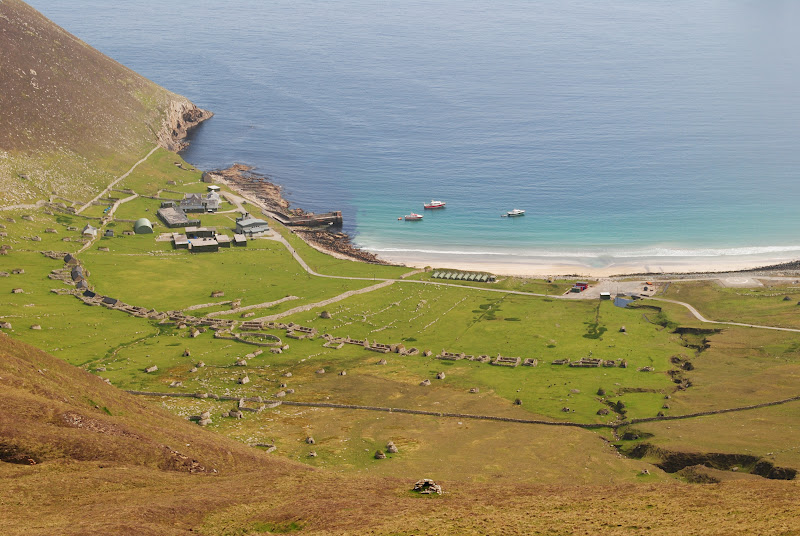
This photo was taken when we were almost at the top of Conachair (430 m, 1411 ft). The village houses can be seen in a line, and close to the sea.


Towards the top-left of the photo, you can see the MOD (Ministry of Defence) buildings. 

It would appear that people have lived on St Kilda for thousands of years. But little is known of life here before the 17th century. At one stage during the 18th century, the population had decreased by so much because of deaths from smallpox that other islanders from Harris were brought there to live. Then, in the middle of the 19th century, in 1851, thirty-six of their men emigrated to Australia.

That was a huge loss to the island, and St Kilda never really regained a healthy population after that.


The row of derelict homes. Most of the houses would have been thatched, though around 1862 some of the homes were given zinc roofs.


Until the 19th century, the people of St Kilda had very little contact with the outside world. The factor, or his representative, would arrive once a year to collect the islanders' rent - normally paid in wool, seabird eggs or such like. A chaplain would make the journey with the factor, and he would perform marriages and baptisms.


These goods would have been stored in a cleitean like the one below, ready for the factor's annual trip.


The gannets hunted on Stac Lee would have been stored here too. Along with this, the St Kildans' diet consisted of some potatoes and barley that they were able to grow, some sheep milk and cheese, and gannet and fulmar eggs. Amazingly, despite being surrounded by sea, they seldom fished. The seas were simply so rough that fishing was just not a reliable option for them.

This reminds me a little of, 'Water, water everywhere, and not a drop to drink'.


The church, which is the best preserved building on the island, was built in the 1800s, primarily through funds raised by The Apostle of the North. The schoolroom (on the right of the building in the photo) was built as an annexe to it.

You may have heard of The Apostle of the North. Rev John MacDonald visited St Kilda four times in all, preaching the Gospel to the people - most of whom lived with some knowledge of Christianity, but whose hopes tended to be placed in outward signs like baptism. The seed sown by Dr MacDonald saw considerable fruit.


I am wondering whether this cloth piece with the embroidered cross would really have been here.

To my Scottish Presbyterian mind, it seems unlikely. But if anyone knows differently, please let me know.


I love this - a map of the world on the classroom wall.

Islanders tend, I reckon, to be much more outward looking than those who live inland, and especially those who live in large towns or cities. Feel free to disagree with this observation, by the way! But it seems that way to me. How often the St Kildans must have traced the sea-path from St Kilda to Australia on this map. Had those who emigrated from St Kilda gone to Canada, it wouldn't have seemed so far. But Australia...? That really was about as far as they could have gone.

Many mothers' hearts must have been almost broken.

Eventually, in 1930, the last inhabitants of St Kilda left the island for good and settled in other parts of Scotland. They had had more contact with the outside world in the decades before this, and knowing there were other - more comfortable - ways of life made them keen to leave.   

And so, St Kilda now lies deserted of true St Kildans. Tourists visit in great numbers, and some wildlife - like the birds - thrive. The wild sheep have mixed fortunes, but surely the history of these hardy people will never be forgotten.


5/25/2012

Butt of Lewis Lighthouse

Some interesting, though possibly useless, facts about our local lighthouse.


The lighthouse was built in 1862 by David Stevenson and his brother, Thomas. David Stevenson was an engineer with the Northern Lighthouse Board.

Thomas Stevenson was the father of the much loved author, Robert Louis Stevenson. 


It stands at almost the same latitude as Whitehorse, Yukon in Canada, and Kristiansand in Norway.


It is officially the windiest spot in the U.K, though tonight it was perfectly calm.

There used to be a foghorn beside it, which sounded until 1995. I have wonderful, comforting childhood memories of its deep, long, low bellow sounding out as I lay snuggled in my bed. 

Sadly, it is heard no more. And I miss it.


The lighthouse was manned when I was growing up. The flashing was caused by a huge lens which revolved around the light. Before it was automated, the lighthouse keeper had to wind up the clockwork motor by hand every half-hour each evening.


Initially, the light was fuelled by fish oil, but between 1869 and 1976 paraffin was used. Since 1976, it has been all electric. 


There are 168 steps to the top of the lighthouse. Sadly, the lighthouse is not open to the public now, so we cannot climb to its top any more. 

Interestingly, the man who was building the spiral stair of steps went on strike for 'an extra penny a day'. Apparently, there were so few experts to do the work that he was given what he'd asked for.


9/06/2011

The Day we Can Never Forget

It's coming close to that day again.

September 11th

9/11


Nobody can hear that date and not think of the awful scenes we witnessed (most of us on television screens) that day.


And surely we can all say we remember exactly where we were when we heard of the events.


I was in London, Ontario, on holiday with my Mum, visiting an elderly relative. We went to see an estate of newly built homes, just for the fun of seeing a Canadian home. I'll never forget that moment when we walked in and the lady at reception was weeping and saying, 'Something awful is happening in America. Something awful'. 


I felt so near and yet so far. I longed to be just across the border. I wanted to be on American soil. I don't know why, and I certainly wouldn't have been of any use to anyone, but I still wanted to be there. I wanted to hold hands, figuratively, with the Americans, and tell them we loved them. I loved them. And prayed for them.


Today, we're almost ten years on from That Day.... the day that changed the world in so many ways. 


For many of us, we remember the events when we see photos, or when we hear the date. We are transported to that time and place when the devastation of the day is in the news, or spoken of on the radio.


But for others, the reality of that day lives with them ever single day. Those who lost loved ones can never, ever forget the day that changed their lives. Others have served in Iraq or in Afghanistan as a direct result of that day. Many have sons and husbands in the military, and they live with the consequences of that day every hour of every day. 


To all of them, we wish to say that we have not forgotten. We still weep when we are reminded of the firemen who lost their lives doing their job in the Twin Towers. We still grieve over those who were on the flights, who had a time of terror before they lost their lives. And we still mourn over those who were at their desks, or at other places of work, just like any other day, and whose lives were cut short by the wickedness of others.


We will not forget.


8/30/2011

Letters from the Past


My mum gave me this bundle of papers the other day: a bundle full of newspaper cuttings, old momentos, funny poems and all sorts of interesting titbits from decades past.


Amongst it all are a couple of letters from my mum’s Auntie Catherine (Kate), whom I mentioned in this post. She left our island in 1924, on the SS Marloch, and died in British Columbian sanatorium just a few years later. One of these letters was written to a cousin of Auntie Catriona, and here are some snippets of that letter:

My dear cousin,
Had your lovely letter a while ago of which I was very pleased, and to learn by it that you are all enjoying the best of health which is a great blessing from the Lord.
Well my dear, I am very thankful indeed to be able to give you a good account of myself and the Barvas boy that’s here [mentioned in this post]. I see him every night. He comes to the window to speak to me. He is a dear boy and a good boy too [‘good boy’ here is a translation of ‘balach math’, meaning he was a believer]. Tomorrow is New Year’s Day and Xmas is over again. Oh how thankful we ought to be to the Lord that we have seen another year coming to an end, and it is Himself that knows who will see the next one coming to an end. Last winter, I never thought I would see this one. Everyone will go when his time comes, but the question is who is ready to go when the Bridegroom comes. We never know when He will come. “Dèanaibh faire air an adhbhar sin, do bhrìgh nach aithne dhuibh an latha no an uair air an tig Mac an Duine.” (‘Watch therefore, for ye know neither the day nor the hour wherein the Son of man cometh. Matt 25:13)

Oh, Annie dear, how I would love to be among you. Tomorrow you will have the New Year’s Service and all the rest of the week [there would be a meeting each evening for the whole of the first week of each year]. Oh, Annie dear, make good use of the privileges you have there. I was in church last Tuesday myself and the Barvas boy listening to an English minister. The text he had was, ‘Glory to God in the highest and on earth peace, goodwill to all men’. This was for the Xmas service. Xmas day means a lot when you come to think on the wonder of that verse, ‘agus rugadh dhuibh an diugh Slànaighear ann am baile Dhaibhidh, neach is e Criosd an Tighearna'. ('For unto you is born this day in the city of David a Saviour, which is Christ the Lord' Luke 2:11). Did you ever think about that old Christian in the second chapter of Luke called Simeon, and what he said when Christ was taken into the temple: ‘Oir chunnaic mo shùilean do shlàinte’ (For mine eyes have seen thy salvation’). But blessed are those who have not seen but believe. Oh Annie, my heart is full tonight!

How I would love to be with you. You made me laugh when I read your letter about when you were in Lowestoft trying to get a hold of Roddy’s hand. I wouldn’t be a bit scared of him now, the way I used to be. Wasn’t the verse he had lovely. It’s special. ‘Eil barrachd gràdh agad dhomhsa orra sin’ (Loves thou me more than these?) [I have no way of knowing what was said in Annie’s letter to her.) Do you know, Annie, that sometimes I feel so good in my soul that I would like to fly out of this body and be forever with the Lord Jesus. 'Who can separate us from the love of Christ'. Let us follow the Lamb, wherever He goes.

I got a nice letter from Malcom Morrison a while ago. I think the world of him anyway, and you were saying that he thinks a lot of me. Oh well, it’s a good thing someone does! May the Lord grant that I will meet him yet before I die. I was so pleased to hear that he sat at the Lord’s Table. Well, dear, you will remember me when you hear him singing. Oh my, ‘s e dùrachd mo chridhe agus m’ ùrnaigh ri Dia [the desire of my heart and my prayer is] to meet you all where there is no more parting, where the Lamb of God will be. My heart would break if I would think that I wasn’t going to be among God’s people in His Glory. Oh, never mind, dear, it wont be long until this night is over.

I am sure Angus is still home. I didn’t answer his letter yet.


Anyway, as I am writing to yourself, it’s just the same.
I was up for Xmas dinner last Saturday and Annie, dear, I felt thankful to be able to do so. I enjoyed it very much. There were 26 tables in the dining room and 6 at each table so you can imagine all the crowd that was there. The doctors and nurses were waiting on us all. They really tried to make everything as cheery as possible for the patients but I would enjoy a Gaelic service more. I got about 20 presents this Xmas and 20 cards from all over, and very useful presents indeed from people I never expected. I really was surprised to get so many, and the girl that’s with me got about 35. Well, my dear Annie, I am sure by the time my letter reaches home, you’ll have the sad news about Mac Mairi Phadraig from Port. I was told that he died in Trail lately with a tumour that was growing near his brain, the same trouble as my cousin Angus from Dell had. How sad to hear of our own dear home boys laid to rest in Trail so far away from their beloved ones, but it doesn’t matter where the body is laid to rest – it’s the soul – to know where that’s going.

Now my dear, I think I’ve said enough just now. It’s after nine and I am supposed to have my lights out soon, so remember me, dear, at the Throne of Grace . And remember me when Roddy is preaching and when Malcolm Morrison is singing. The dear soul. Love to Angus and to you all. Also the MacRitchies and not forgetting your uncle Callum. I never answered his letter. I don’t like to bother him – that’s why. Love to your crew, and to everyone. How are they in our own house?

Write again soon. I am so longing to hear from you.
Your loving cousin, Kate.
Happy New Year to you all.


Doesn't it make you cry... All on her own, in Canada. Dying of TB, and not a family member in sight. And yet, 'underneath were the everlasting arms'. She was safe in the arms of Jesus, so I shouldn't feel so sad. She passed away shortly after this letter was written, and it's easily seen from the letter that her soul was prepared for meeting her Saviour. What joy there was then for her! No more sadness, no more missing her homeland, or family or friends. No more parting. I'm glad I know this about her, otherwise I'd be really sad.


Here she is, photographed during the First World War, just a few years before she emigrated.


8/13/2011

Àirigh a' Bhealaich

Remember the day we went to Cuidhshadar? Well, when we'd finished our time at the beach, we went for a stroll down memory lane.


When the Builder and his siblings were young, they used to spend whole summers out here on the moor. Five weeks (going home at weekends) on the moor: no running water, but a crystal clear running stream; no electricity; no internet, consoles or gadgets.

Just mile after mile of empty moor - empty, but full in a child's imagination.


And each of the ruins of shielings here holds memories for them. Where, today, only one wall, or a chimney remains standing, a generation ago these were shielings which, over the summer, were teeming with life.

Today, they teem only with memories. And stories, forever engraved in the hearts of those who spent time out here.


The last few summers the Builder's family spent out on the moor was spent in this shieling. DR is standing at the chimney, but the following photo shows the inside of the àirigh, which was built into the side of the hill.


Here's where the fire was. Do you see a blue kettle still sitting in there? 


The feelings that rushed back into the Builder's mind and to his siblings' were so strong. For a long time, we just stood and allowed them their memories. There may even have been a tear or two.

None of those of whom they spoke, who spent time out there over summers are here. 

All the stories of 'Remember when....', were of people who were full of life then, but are now gone.


Although we now have a younger generation of people who are, once again, discovering the delights of spending time out on the moor in simple àirighean, we saw nobody that day.


I felt that each ruin, or even each àirigh seen from a distance, spoke like memorials to another time, another generation.


Almost like walking through a cemetery, and reading the writing on memorials. To me, they are just that: memorials to people whose names I recognise, and to a way of life of which I knew nothing.

But to the Builder and his family? Each 'memorial' spoke volumes. In fact, they did more than speak: they bellowed - albeit quietly. For out here, there are no loud noises.


3/07/2011

Gaelic Place Names

Place names always fascinate me. Here in Scotland, the root language of a place name, as well as its actual meaning, can tell something of the history of the village or town, or of its physical features.

On the drive between Inverness and Ullapool, I took some photos of road signs, showing the names both in English and in Gaelic.

Many English names in this area are simply Anglicized versions of the original (Gaelic) name.

This is easily seen in this photo.

Contin in English, Cunndain in Gaelic;
Garve in English, Gairbh in Gaelic;
Ullapool in English, Ulapul in Gaelic; and Gairloch in English and Geàrrloch in Gaelic.

However, other times, the names in Gaelic and in English are totally different. At times, this is because the words have been translated from one language into another. For example, you may have a river called The Black River in English, with the Gaelic - an exact translation of this - being, An Abhainn Dhubh.

In this example, the meanings are the same, but the 'look' of the names bear no relation to each other.

The photo below has the Ullapool/Ulapul example, but it also has some very interesting place names which would not come into that category.

Beauly. The English name for this town comes from the French, beau lieu, meaning 'beautiful place'. Clearly beau lieu was Anglicized and the resulting name remains. The name would have come from French monks who once lived in Beauly...

...and so to the Gaelic name.

A' Mhanachainn means a monastery or a priory, relating to the aforementioned priory which was built here in the 13th Century. The ruins of the priory are still to be seen in Beauly, and there is an eight-hundred year old elm tree standing at the entrance to the graveyard. 

In this case, the Gaelic has neither been translated nor Anglicized. But the two languages are able to open up the history of this bonny little place near to Inverness.

Around ten years ago, the Scottish Government decided to display bilingual place names in many areas of Scotland. For Gaelic speakers, or for those with an interest in the language, this (as I think I showed above) can begin many an interesting conversation about various places.

Having two languages is a gift I am glad to have been given, by virtue of where I was born and brought up. Each language is special to me, though in different ways.

Because I have English, I can go almost anywhere in the world and find someone who understands me (Central Scotland excepted: here, I find the common response to anything I say is, 'Wha?' or 'Uh?' or 'I dinna ken'.)

Gaelic is different. It may be of little international consequence, but when I am able to speak to someone in Gaelic, I feel a bond, a sharing, a connection, a something. 

In some conversations, I speak only English. In others, only Gaelic. My highest comfort zone is when I'm able to speak one language but chuck in words or phrases in the other language which express more fully what I'm trying to say. That's what most of 'us locals' do when we're together.

Oh, there are two groups to whom I simply cannot speak English: babies and dogs. 

It's my native mother tongue for them. Don't ask me why, but I feel so odd speaking to a baby or to a dog in English. They're too cute, I think, to have such an official language spoken to them.

Co-dhiù, 's fheàrr dhomh falbh, 's làn thìde agam a bhith na mo leabaidh. Oidhche mhath.
Related Posts with Thumbnails